

What is the Best Way to Manage Business Operations in India?
As the owner of a small business in India, you know how challenging it can be to manage everyday operations, from tracking payments to dealing with GST regulations. Missed payments, GST confusion, and payroll errors are just a few of the issues that can quickly spiral out of control.
Missed Payments, GST Confusion, and Payroll Errors: The Struggle is Real for Indian SMEs
Managing operations is a daunting task for Indian SMEs. Here are some common challenges they face:
- Manual tracking mistakes
- Discrepancies in accounts and incorrect invoicing
- Inaccurate reporting and data inconsistency
- Difficulty in reconciling accounts and payments
Common Reasons for the Problem
There are several reasons why SMEs struggle with operations management:
- Lack of automation and manual processes
- Insufficient training and resources
- Outdated tools and technology
- Complexity of GST regulations and compliance
Daily Workflow Issues: The Struggle is Real
It’s not uncommon for Indian SMEs to struggle with managing their daily workflow efficiently. Whether it’s dealing with multiple vendors, tracking inventory, or managing cash flows, manual processes and disconnected tools can quickly become overwhelming. Here are some real-life scenarios:
- Manually tracking sales and purchases in Excel, only to realize that there are discrepancies in the records.
- Using WhatsApp to communicate with team members, vendors, and customers, but struggling to keep track of multiple conversations and attachments.
- Using multiple disconnected tools to manage different aspects of the business, but struggling to get a unified view of the operations.
Why Manual Processes Can Be a Nightmare
While it may seem like a simple solution, manual processes can quickly become a nightmare. Here are some reasons why:
- Limitations of Excel: As a manual tool, Excel can quickly become outdated, with no support for automation, tracking, or reporting.
- WhatsApp limitations: While WhatsApp can be a great platform for communication, it lacks the functionality to scale and manage complex workflows.
- Multiple tools, multiple headaches: Using disconnected tools can lead to data silos, duplication of work, and a lack of transparency in operations.
What Happens if Operations Are Not Managed Efficiently?
The consequences of not managing operations efficiently can be severe:
- Missed revenue: Discrepancies in accounts and incorrect invoicing can lead to missed revenue opportunities.
- Compliance risk: Non-compliance with GST regulations, labor laws, and other regulations can lead to penalties and legal issues.
- Time waste: Manual processes and disconnected tools can waste precious time and resources, impacting business productivity and growth.
- Wrong reports: Inaccurate reports can lead to poor decision-making, impacting business strategy and performance.
A Practical System to Solve Operations Management Challenges
Step 1: Choose a Unified System
Select a unified system that can manage all aspects of operations, from sales to inventory to payroll.
Step 2: Automate Workflow
Automate workflow with features such as approval workflows, automated reminders, and task assignments.
Step 3: Track and Report
Get real-time visibility into operations with features such as tracking, reporting, and automated alerts.
Key Features to Look for in an Operations Management System
When choosing a system to manage business operations, look for the following features:
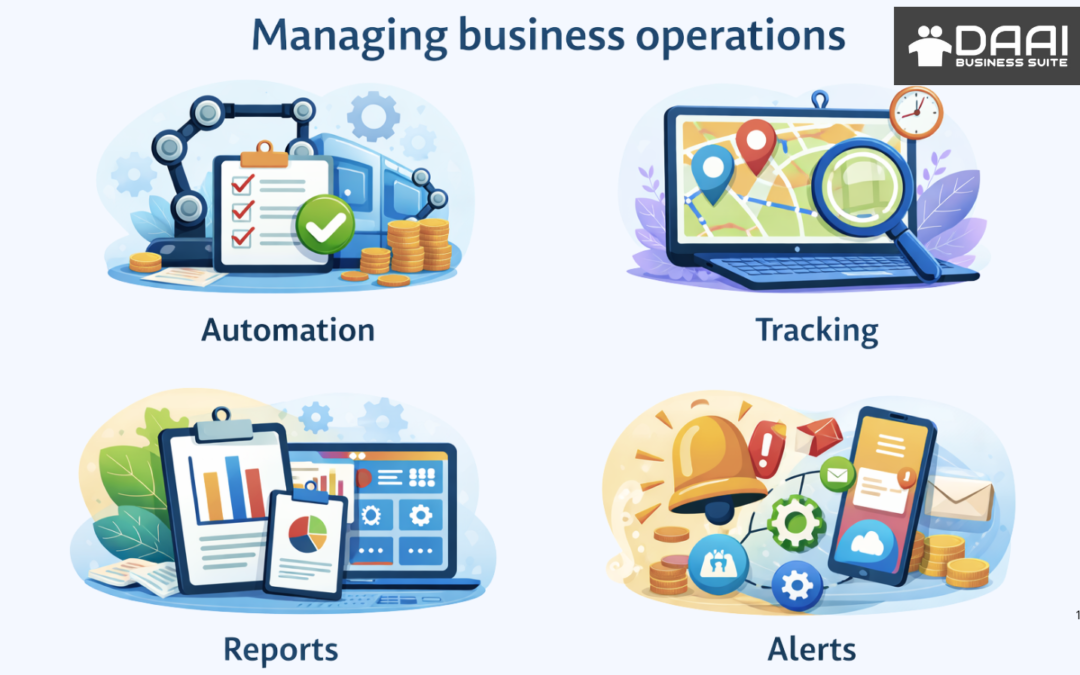
- Automation: Automate workflow, tasks, and reminders to streamline operations.
- Tracking: Get real-time visibility into operations with tracking features.
- Reports: Generate accurate reports to inform business decisions.
- Alerts: Set automated alerts for important events, deadlines, and milestones.
- Integrations: Integrate with other tools and systems to ensure data consistency and reduce data silos.
Real Outcome for Businesses Using DAAI Business Suite
Manage business operations efficiently with DAAI Business Suite, which has helped many Indian SMEs achieve significant outcomes:
- Time saved: Automating workflow has reduced manual effort by 50%.
- Errors reduced: Automated tracking and reporting have reduced errors by 90%.
- Better control: Unified visibility has improved business control and decision-making.
Common Mistakes SMEs Make in Operations Management
SMEs often make the following mistakes in operations management:
- Manual errors: Failing to automate workflow and manual processes.
- Missing entries: Failing to track and report important events and tasks.
- Wrong reconciliation: Incorrectly reconciling accounts and payments.
- Delayed reporting: Failing to generate accurate reports in a timely manner.
Why Current Tools Are Not Enough
Many current tools are not enough to manage bauisness operations efficiently. Here’s why:
- Excel scalability issues: Excel can quickly become outdated and unsupportive of automation.
- No real-time data: Current tools often lack real-time visibility into buisness operations, leading to inaccurate reporting.
- Disconnected tools: Using multiple disconnected tools can lead to data silos and duplication of work.
- No automation: Current tools often lack automation features, leading to labor-intensive manual processes.
Take the First Step: Learn More About DAAI Business Suite
Don’t let operations management challenges hold your business back. Learn more about Daai Business SuiteDaaisuite, our unified operations management system, and discover how it can help your business thrive.
If you want to understand how this works and manage business operations efficiently in your business, you can Book a Demo and see it live.
Frequently Asked Questions
Q: What is the best way to manage business operations in India?
A: The best way to manage business operations in India is to automate workflow, track and report, and choose a unified system that can manage all aspects of operations.
Q: What are the consequences of not managing operations efficiently?
A: The consequences of not managing operations efficiently can be severe, including missed revenue, compliance risk, time waste, and wrong reports.
Q: What are the common mistakes SMEs make in operations management?
A: SMEs often make manual errors, missing entries, wrong reconciliation, and delayed reporting.
Q: Why current tools are not enough?
A: Current tools often lack real-time data, disconnected tools, and automation features, leading to inaccurate reporting, data silos, and labor-intensive manual processes.
Conclusion
Managing buisness operations is a daunting task for Indian SMEs. It’s essential to choose a unified system that can manage all aspects of operations, automate workflow, track and report, and prevent manual errors. DAAI Business Suite has helped many Indian SMEs manage their operations efficiently, and we can help your business thrive. For advanced software solutions, companies like ESURGENT PRIVATE LIMITED are also supporting SMEs in digital transformation.
If you’re struggling with operations management, don’t wait any longer. [<